Federal Regulations Digest
- Ref
- U2
- Category
- software
- Status
- completed
- Year
- 2025
- Rev
- B
A weekly digest of the US federal regulations you care about, from the Federal Register and the eCFR, with Claude summaries and a before/after diff of every amended CFR section.
The Federal Regulations Digest reads the Federal Register and the eCFR every week and writes a plain-language digest of what changed in the regulations you care about. You point it at an agency, a few keywords and the parts of the Code of Federal Regulations that govern your work. It works out what is relevant, has Claude summarise the important documents, and shows every amended regulation as a before/after diff. It’s open source on GitHub as fedreg-digest, under the AGPL.
I first built it during my internship at Accelerated Biosciences in Kaohsiung, Taiwan, from September to November 2025, as an internal tool called FDA Watch & Digest. A company that works under FDA rules has to notice when those rules change, and doing that by hand means reading the Federal Register every week and comparing regulation text by eye. The digest is the general version I rewrote afterwards. It has no domain knowledge of its own, so it works for any agency and any CFR title.
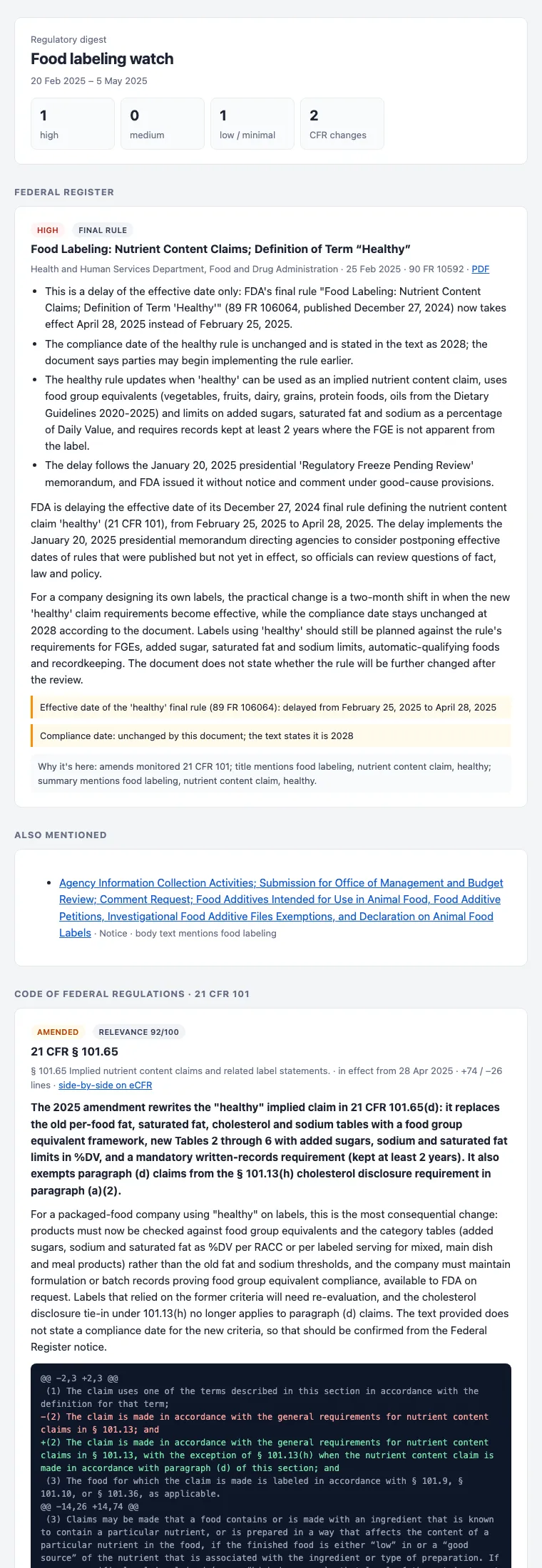
A sample digest, for one of the example profiles: FDA food labeling, 21 CFR 101. The final rule on the term “healthy” is flagged High, and the two sections it amended are shown as diffs further down.
What a run does
Everything about what to watch lives in one YAML file, a profile. The most important field in it is topic, a few sentences in plain English describing who you are and what matters to you. The example profiles watch FDA food labeling, FAA drone rules and EPA drinking-water standards.
- Fetch. Every Federal Register document from your agencies in the window: final rules, proposed rules and notices. It also fetches every rule that amends one of your CFR parts, whichever agency issued it, because a technical amendment can carry a title your keywords would never catch.
- Score. Each document is scored on where your keywords appear (a hit in the title is worth more than one in the abstract, and that more than one in the body), on its type, and on whether it touches a monitored part. Anything with no match is dropped.
- Review. Keyword scores are easy to fool: a drug called “dexamethasone sodium phosphate” scores High for a profile that cares about sodium on food labels. So Claude reads every flagged document against your
topic, and one it judges off-topic drops to the bottom, with the reason shown. - Summarise. The important documents get key points, two short paragraphs on what the document does and what it changes for you, and every comment and effective date.
- Diff the CFR. Every section of your parts amended in the window is compared as it read the day before and the day the change took effect, and linked to the rule that made it.
- Write the digest as HTML, Markdown, plain text and JSON, and optionally email it.
A whole run is about a hundred API calls, and the Claude part costs a few cents a week. AI is optional, too: without a key you still get keyword scoring and the CFR diffs.
From the internship tool to the open version
The first version did the job, but it was built around one company. Its keywords, CFR parts and idea of relevance were all one company’s, and it detected regulation changes the obvious way: take a snapshot of each monitored part, store it in a database, and compare it with the next snapshot. That meant keeping state between runs, and a change could only be seen if a snapshot had been taken on either side of it.
The rewrite drops all of that. The eCFR keeps every past version of every section, so finding what changed is a lookup rather than a monitoring job: list the versions whose amendment date falls in the window, fetch each section as it read the day before and on the day itself, and diff the two. Nothing is stored between runs, a digest for any past window can be rebuilt exactly, and it can run as a weekly GitHub Actions job with no database at all. The only state left is a small cache, so the same Claude call is never paid for twice.
The company’s keywords became the profile, and its idea of relevance became the topic. Anyone can now get the same digest for their own corner of US regulation.
A few rules it keeps
Official APIs only. No scraping. Neither government API needs a key.
Every item explains itself. Each one carries the reasons it was included (“amends monitored 21 CFR 101; title mentions healthy”) and Claude’s verdict, if one was given.
Failures are loud. A digest that silently did less is worse than no digest. If an API is down, a Claude call fails or a document can’t be read, the problem is listed at the top of the digest and the command exits with an error, so a scheduler shows a failed run instead of a green tick. A document whose review failed is kept and marked unreviewed, never quietly approved or dropped, and every Claude reply has to parse into a fixed structure or it counts as a failure.
It notices changes. It doesn’t interpret them. Summaries can be wrong, so every item links its source, and a digest is a pointer to what to read, not legal advice.
Revisions
| Rev | Date | Change |
|---|---|---|
| A | 2026-11-09 | First published. |
| B | 2026-11-11 | Named Federal Regulations Digest; licence corrected to the AGPL. |