xiehanzi 写汉字
- Ref
- U5
- Category
- software
- Status
- in use
- Year
- 2026
- Rev
- B
Daily Chinese handwriting sheets for the Supernote that grade themselves from the pen strokes.
xiehanzi (写汉字, “writing characters”) generates a Chinese handwriting sheet for my Supernote every morning, and grades it from my pen strokes in the evening. Anki flashcards only really test whether I can recognise a character, and a deck can be almost entirely mature while most of its characters still can’t be written from memory, so writing gets its own state and its own schedule here and is never inferred from Anki intervals.
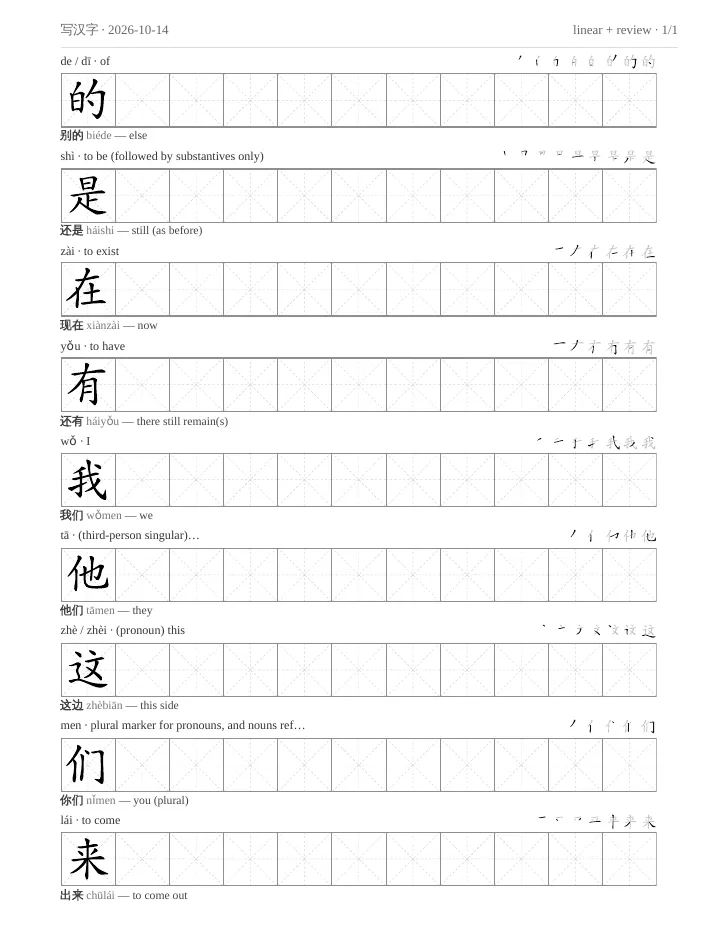
A generated sheet: 米字格 practice rows with the model character in the first cell, the stroke order above each row and an HSK example word below.
How a day works
Each sheet is a real Supernote .note notebook, uploaded to Supernote Cloud, so on the device it is just another notebook (no PDF import, no annotation layer). In the morning, a scheduled job first grades whatever sheet came back since the night before, so the new one already reflects it. If the last sheet came back with no ink at all, it isn’t replaced: it gets renamed to today, so the tablet never holds two blank sheets. Otherwise a new one is planned, in order: characters I pinned myself, optionally some review words from Anki, and then the next characters on the HSK 3.0 list, band by band, nine a day by default.
A sheet has two halves. The drill rows are for copying, with the model character in the first cell and the stroke order above it. Before them come the recall rows, one for every character that is due, written as a gap in a word (城_ chéngshì, city), where I have to write the missing character from memory. A solutions page sits between the two, so I can check myself afterwards. Only the first cell of a recall row is graded, and the rest of the row is for writing the correction once I’ve seen the answer.
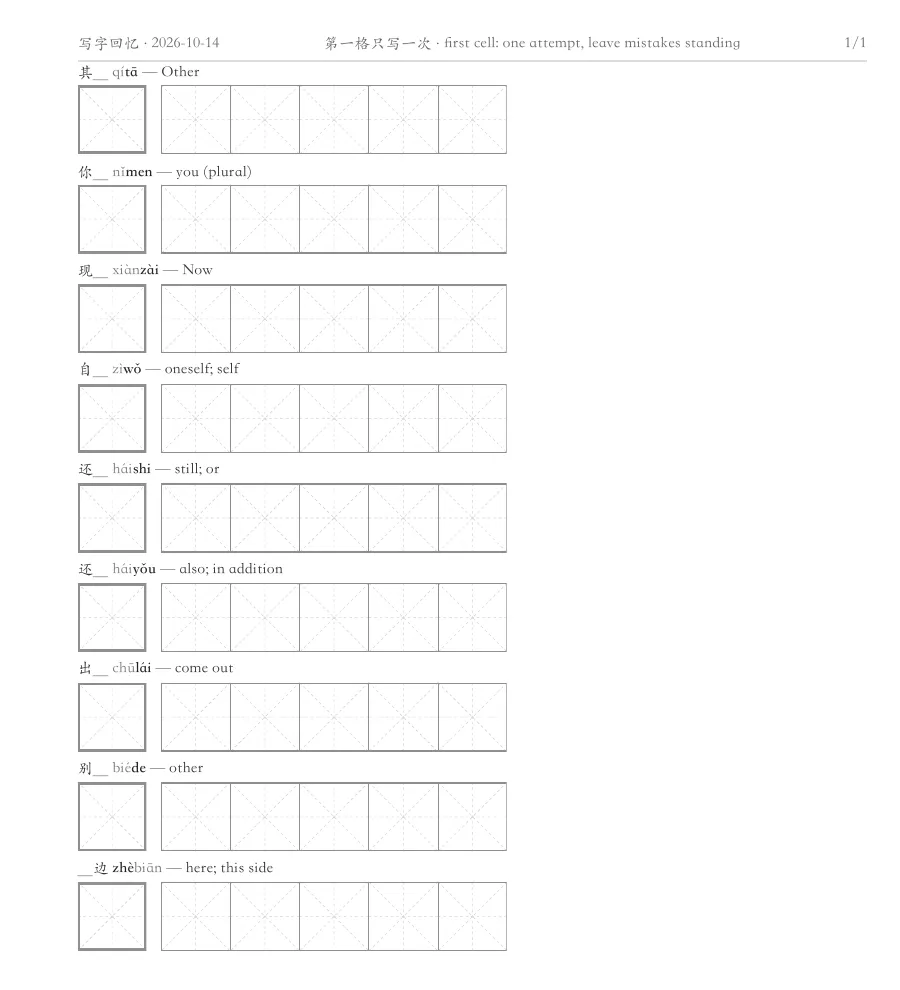
A recall page, generated for this page from a made-up history. The missing character is the bold syllable in the pinyin, and the bold-bordered first cell is the one attempt that gets graded.
Recall only ever asks for the 1,200 characters HSK 3.0 expects you to write by hand, not all 3,000 you need to recognise, and only once a character has actually been drilled. In the evening a second job pulls the written-on notebook back, grades the recall rows, and each result feeds an SM-2 schedule (1 day, then 3, then interval × ease). A character that fails twice goes back onto a drill sheet to be taught again, and then re-enters recall.
Reading the handwriting
The .note format is undocumented, so I built the writer and reader by taking apart notes the device had made. As it turns out, each page stores every pen stroke in the order and direction it was drawn. That matters, because there are two ways to recognise handwriting: offline, from a picture of the finished character, or online, from the movement of the pen while it was being written. Online recognition knows the stroke order and the direction of every stroke, which a picture throws away, and for Chinese that makes it far more accurate.
So for each graded cell, the strokes are sent to Google’s handwriting recogniser (the one behind Gboard), one character at a time and with nothing else attached. On a benchmark of 101 labelled cells, the Supernote’s own transcription got 27 wrong and Google’s recogniser got 6 wrong.
A recogniser will still snap a badly written character to the nearest real one, so its answer has to get past a couple of checks. The first counts strokes: anything more than one stroke off the reference fails, which catches most of the malformed characters it would otherwise wave through. The second handles confusions. If I write 作 when 做 was asked, 做 fails, and if 作 is also a character I’m learning and a second check agrees that’s what I wrote, 作 fails too, seeing as I clearly don’t have that one either. I also tried a vision model as a second opinion, and it did better on the benchmark, but on my real history it rejected more correct answers than it caught wrong ones, so it’s off. With all of this, the grader gets 5 of 126 cells of my handwriting wrong.

Recall cells from the evaluation set, written from memory on the device and labelled by hand. The failed 样 was written with 禾 instead of 木, and the recogniser read it as 样 anyway, which is why the stroke check exists.
None of it is self-reported. The schedule is replayed from an append-only log of reviews rather than stored, so it can’t drift from what I actually wrote. A sheet that comes back blank records nothing, grading the same day twice changes nothing, and if the recogniser is down the day is marked degraded and graded again on a later night.
Revisions
| Rev | Date | Change |
|---|---|---|
| A | 2026-10-14 | First published. |
| B | 2026-10-28 | Card cover cut between rows, so no half row shows. |