The technician and the publisher
- Ref
- U4
- Project
- Atlas Agent
- Sheet
- 3 of 4
- Rev
- C
Two agents that sit beside Atlas, one fixing the system it runs on and one taking things from my notes onto my websites.
Besides Atlas itself there are two more agents, each with its own directory, its own instructions and a much narrower set of tools. Neither of them talks to Atlas directly, they each work from a folder of files that Atlas or a scheduled job fills up.
The technician
When Atlas runs into something broken in the middle of a task (a tool returning errors, a job that did nothing, a number that can’t be right), it doesn’t stop to fix it. It writes the problem up as an issue, which is just a markdown file in a folder, and carries on with what I asked for, and the technician then works through that folder.
I split the two in late August, seeing as they need to think about very different things. Atlas looks after my life, while the technician looks after the system all of that runs on (the scheduler, the servers, the logins and the logs), and it’s blocked from my calendar, mail and vault so it doesn’t drift into the other job.
Every issue follows the same template, with the exact command that failed and its full output, whether the failure was silent (those get marked high severity even when they seem minor), what has already been ruled out, and any workaround Atlas is using in the meantime. The technician picks issues by severity and then by age, has to reproduce a problem before changing anything, checks a fix by actually running whatever was broken, and then moves the issue to a resolved folder with a note on what fixed it. If something needs me, for example a macOS permission that can only be granted on the mini itself, it says so in the issue and tells me in one line. Since 21 August, 109 issues have been filed this way and 95 of them resolved.
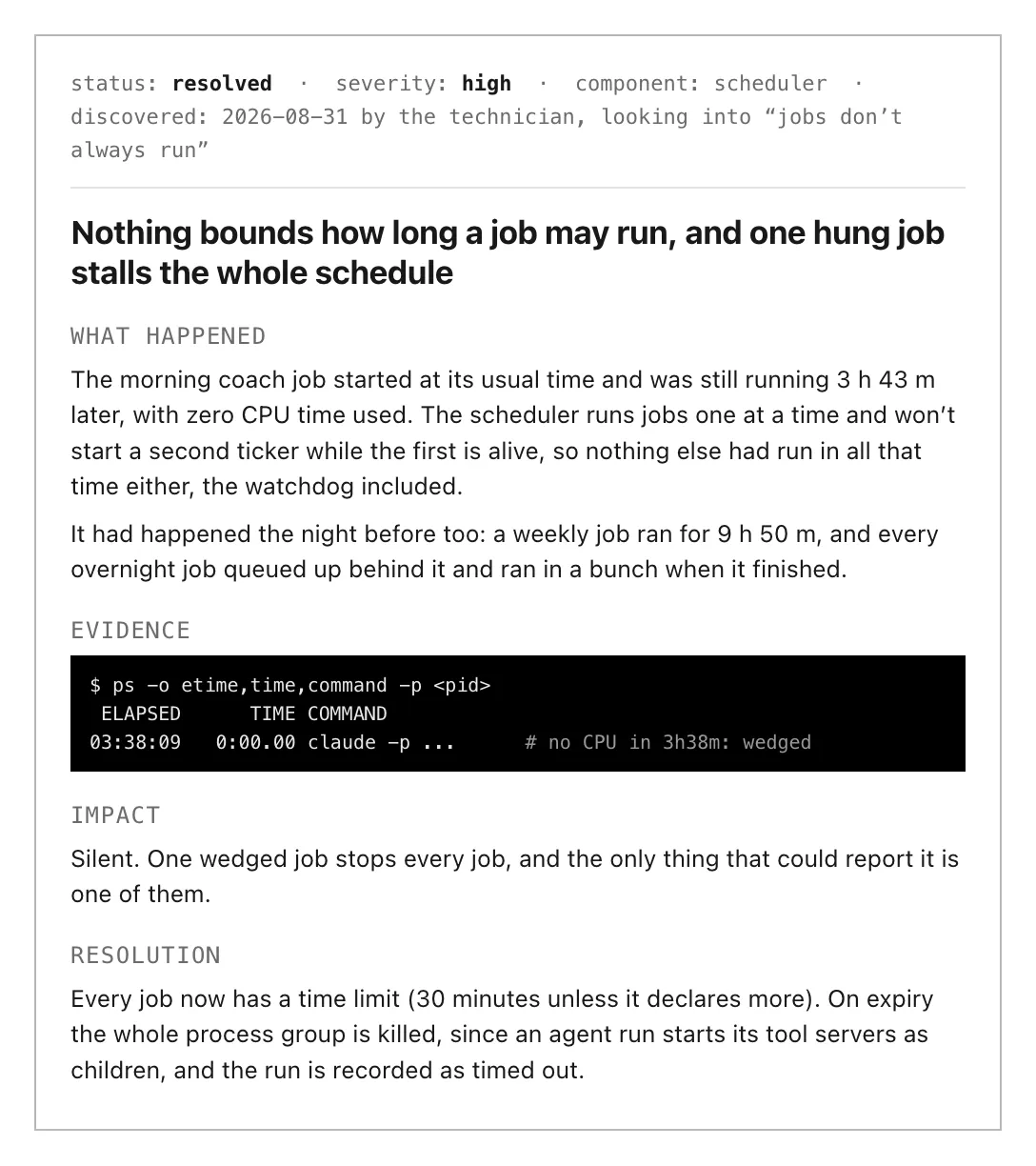
A real report, shortened and with the details about the machine taken out.
Not everything in the folder is a bug, though. When a scheduling session had to ask me how long a drive would take, because Atlas had no way of working it out, the missing piece got written up the same way, as a proposal comparing the options, with the one decision only I could make (whether I was fine with a card on file) left for me, and then it was built.
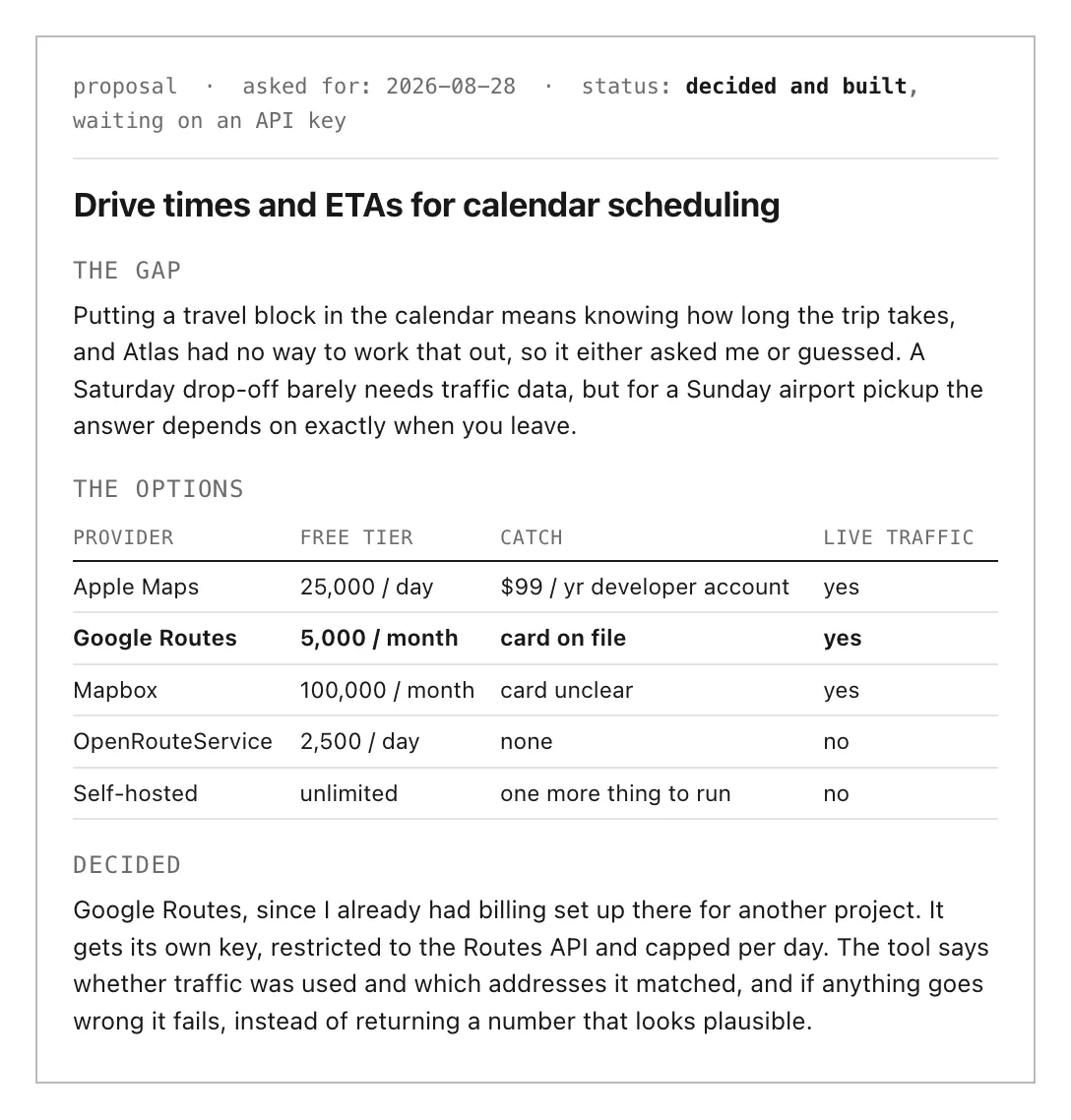
*The proposal for drive times, shortened. Google Routes has live traffic, and I already had billing set up there, which settled it.
The publisher
The publisher looks after my four websites: franco.international, the garden, my CV and this site. Its job is to take things from my notes and my project repositories and turn them into public pages, without anything private coming along with them, and it’s the agent that wrote this page.
Once a week a plain script goes through my vault for notes I’ve marked to publish and for published pages that have gone out of date, and puts what it finds into a queue. The publisher then drafts a public version of each one in a branch of the right site, and before it’s allowed to open a pull request, a sanitizer checks the draft for anything private, such as addresses, coordinates, file paths, keys or health numbers. Photos have their location data stripped as well, since a picture can give away where it was taken even when nothing in the text does.
The pull request then builds a preview of the site, so I see what the page will actually look like and not just a diff, and nothing goes live until I merge it myself. The publisher can read my vault but never write to it, and even then it doesn’t open the files itself, it only gets what the weekly script and a separate read-only service hand it.